Record keeping
How to Document DIY Vehicle Maintenance for Warranty Questions
A receipt shows what you bought. A completion note records what you actually did. Save both with the reading, source, and a few labeled photos.
By Sebastian · Published · Updated · 6 min read
What a DIY record can and cannot prove
A good DIY record can show what you documented, when you documented it, and which evidence you kept. It cannot certify the quality of the work, the vehicle's safety, or the outcome of a warranty claim.
The written warranty or service contract controls its own coverage. The FTC says a warranty company may ask for maintenance records, so keep the record accurate and avoid promises the evidence cannot support.
For U.S. vehicle warranties, the FTC says coverage cannot be denied solely because routine maintenance or repairs were done elsewhere. The written warranty and any separate service contract still control their own terms.
This guide explains a record-keeping workflow for U.S. owners. It is not mechanical or legal advice.
Check the documents that govern the job
Start with the owner's manual, manufacturer schedule, written warranty, and any separate service contract for the exact vehicle. Those documents matter more than a generic interval copied from another model.
The FTC advises owners to compare shop recommendations with the manufacturer schedule and ask why extra work is being proposed. Use that same discipline before documenting a DIY job.
Save the document title, model or year range, page, revision, or URL that informed the work. A short source note is easier to review later than an unlabeled screenshot.
Create the record while the details are still in front of you
Update the record before the tools, packaging, and receipts disappear. Capture the reading from the vehicle or machine instead of trying to reconstruct it later.
Use plain language and describe only completed work. A future reader should not have to decode a parts-store receipt or guess which vehicle received the service.
- Exact asset and completion date
- Mileage, kilometers, or engine hours
- Work actually completed
- Parts, fluids, and identifiers worth keeping
- Manual, schedule, or other source used
- Cost, receipt, labeled photos, and a clear DIY note
Build one evidence packet for one completed job
Keep the completion note, parts receipt, manual page or source, and labeled photos together. The packet shows which purchase belongs to which job.
Label photos by what they show and when they were taken. A clear meter photo can support the reading, while a part label can preserve an identifier that may be hard to find next time.
The same packet works for oil changes, tire rotations, belt replacement, brake pads, and inspections. The FTC names those as examples of maintenance records worth keeping.
Keep original receipts when a warranty, service contract, tax rule, legal requirement, or claim process calls for them. A digital copy helps with retrieval but may not replace an original.
Separate purchased, planned, and completed work
A receipt proves a purchase. It does not prove that a part was installed, that a fluid went into the correct vehicle, or that the work followed the applicable instructions.
Keep a shopping list or estimate as planned work until the job is finished. Then write a completion note and attach only the evidence that belongs to that event.
If a part was returned, a task was skipped, or the scope changed, say so. Honest gaps are more useful than a polished history that overstates what happened.
DIY and shop work on one timeline
Keep DIY and professional work in one asset history, but label who performed each job and retain its original documentation.
For shop work, the FTC recommends a completed repair order that lists the repairs, parts, costs, labor, and odometer readings. Save the final order, not only the estimate.
Keep recommendations separate from completed work. A technician's suggested follow-up can become a reviewed reminder, but it should not appear in the service history as a finished repair.
The multi-source reconciliation guide shows how to match DIY evidence with dealer and shop records without erasing the original files.
Correct gaps without rewriting history
If you entered the wrong reading or part number, preserve a visible correction and the reason for it. Silent edits make a long record harder to trust.
If you document older work from memory, label it as a later recollection and keep the date or reading unknown when you cannot verify it. Do not turn an estimate into an exact fact.
The EPA's emissions-warranty guidance tells DIY owners to keep a detailed work log and parts receipts. It also points owners back to the manufacturer's specifications.
Use the record for the next question
When a warranty, service-contract, technician, sale, or handoff question comes up, share the narrow record and source that answer it. Remove unrelated addresses, account details, and payment information first.
After each job, create the next reminder only from a reviewed source. Keep the date, mileage, or hour threshold connected to the asset and the evidence behind it.
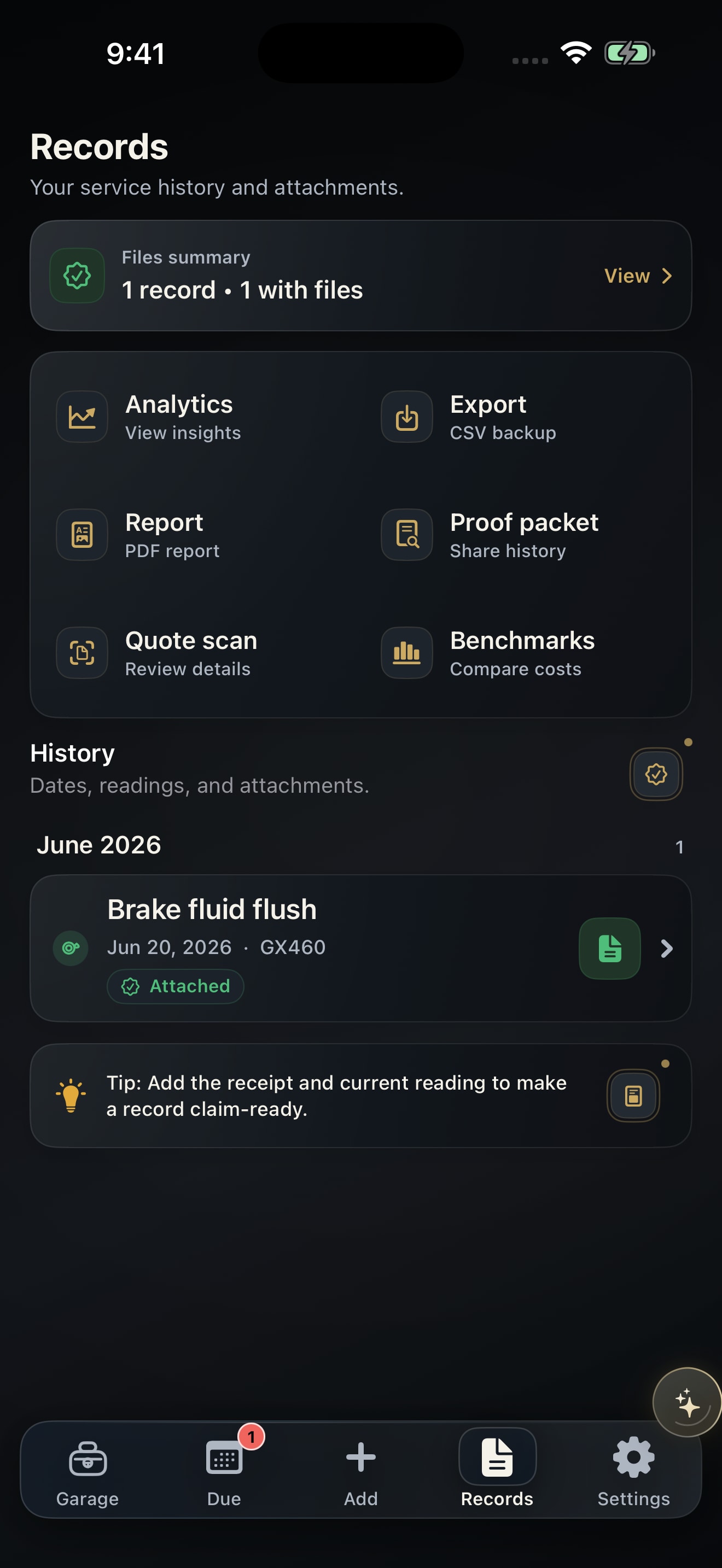
A ServiceVault entry can put the reading, parts receipt, photos, and notes in one place. It records what you saved; it does not certify the work or decide warranty coverage.
Sources and further reading
- Federal Trade Commission: Auto Warranties and Auto Service Contracts
- Federal Trade Commission: Auto Repair Basics
- Federal Trade Commission: Warranties
- U.S. Environmental Protection Agency: Emissions Warranties for 1995 and Newer Cars and Trucks
See how I check each guide or report a correction.
Sources checked .